The Daily Jeddojehad (Struggle) website, jeddojehad.com, was banned in Pakistan on August 4. Launched in 2019, Jeddojehad was Pakistan’s first and only socialist (online) daily, posting reports in Urdu, Pashto and Persian. While there was no official notification or explanation, the ban has been imposed owing to Jeddojehad’s coverage of Pakistani-administered Jammu Kashmir (PaJK).
On August 6, the ISI (the Inter-Services Intelligence) raided Editor of Jeddojehad, Farooq Sulehria’s family home to arrest him. In his absence, his younger brother and two nephews were arrested. The ISI is military’s intelligence agency. While it has no legal authority to conduct such raids, an all-powerful military/ISI is considered beyond the law. The pretext to justify the raid, the ISI staffers offered to Sulehria’s family, was his articles he wrote on Kashmir.
Since Farooq Sulehria was abroad at the time of the raid, he escaped the arrest. However, he can not return to Pakistan where he teaches at Beaconhouse National University, Lahore, as an Assistant Professor. Based in PaJk, his co-editor, Harris Qadeer, is in hiding ever since the ban. Qadeer works as a Jeddojehad full-timer. Previously, Qadeer edited a PaJK-based broadsheet, Daily Majadla (Dailectic). Daily Majadla was also banned, exactly eight years ago in August 2018, owing to its hard-hitting reporting.
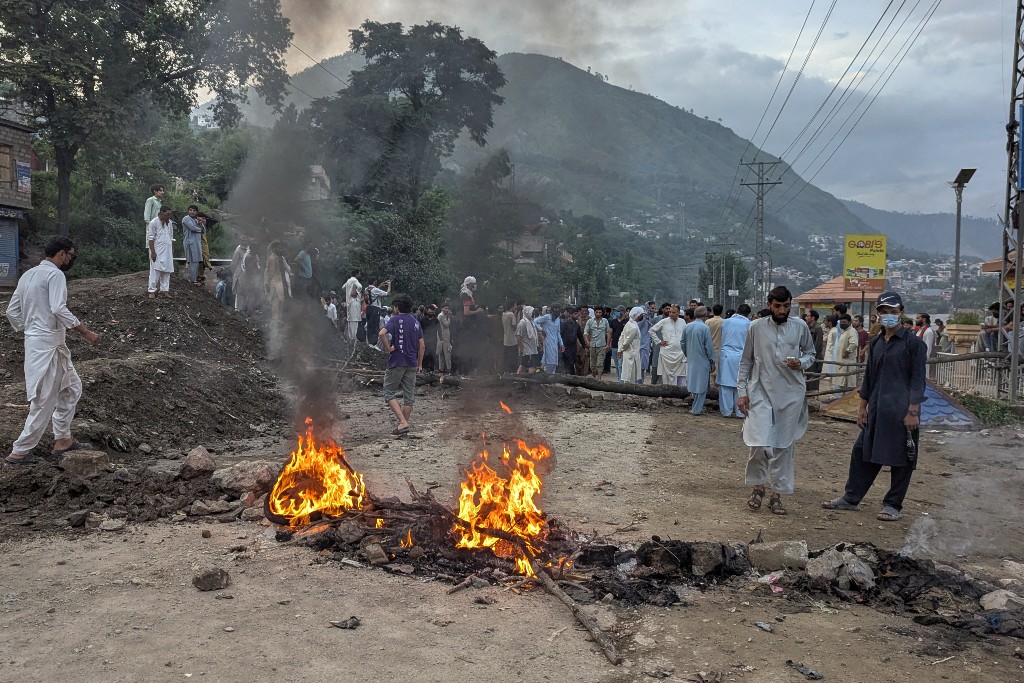
Meantime, since June 5, PaJK has been convulsed by a mass uprising. The state has responded with outrageous violence. At least, 90 people have been gunned down since June 5. The mass movement, spearheaded by the Joint Peoples Action Committee (JAAC), is demanding better governance and an end to election manipulation (see, Pakistani-Ruled Kashmir Is Facing a Brutal State Crackdown).
The banning of Jeddojehad is not an isolated event. The axe fell on Al Jazeera too. Al Jazeera was also banned in Pakistan on the morning of August 4. According to the Ministry of Information and Broadcasting, Al Jazeera was guilty of “yellow journalism”. Al Jazeera has been proscribed because of the critical coverage of sham elections in PaJk conducted, amid violence and repression, during July in three phases. The Al Jazeera correspondent was guilty of pointing out, in his live reporting of elections, that the polling stations were largely empty. Notably, while most global media outlets have ignored the ongoing state-violence and peaceful struggle in PaJk on the JAAC platform, Al Jazeera was consistently covering it, even if the coverage was somewhat problematic.
Likewise, noted journalist-Youtuber Danish Irshad, based in Rawalpindi (Pakistan) but hailing from PaJk, has been placed on Pakistan’s Fourth Schedule. The Fourth Schedule is a notorious terrorism watchlist that exposes Irshad to state monitoring and a set of legal restrictions on his movement, finances and public life (for details, Kashmiri Journalist Danish Irshad Added to Pakistan Terror Watchlist). Irshad, previously working with country’s largest news channel, Geo, was covering the situation in PaJk on his social media platforms. He also interviewed Jeddoejhad editor, Harris Qadeer. In fact, Qadeer, in recent weeks, was not merely interviewed by Pakistan or PaJk-specific youtubers but has been quoted in international media outlets in their coverage of PaJK’s ongoing turmoil. He often features, as an expert commentator on PaJk, in media and research reports.
Ironically, days before the Pakistani state imposed a ban on Jeddojehad, the Indian state banned not merely Daily Jeddojehad’s Facebook page in India but the Facebook pages of both its editors remain banned in India.
The day, a ban was placed on Al Jazeera, Pakistan’s Ministry of Information and Broadcasting also issued strict instructions for the international media operatives in Pakistan. According the new ‘Foreign Media Facilitation Guidelines 2026’ issued on August 4, foreign correspondents, including Pakistani journalists working for global media, are required to obtain a No Objection Certificate (NOC) to cover news outside the metropolitan cities of Islamabad, Lahore, and Karachi in a country of 280 million. Besides an advice to seek the NOC, the guidelines also stipulates a not-so-concealed threat to journalists working for international media: they may have their accreditation revoked in case of “acts contrary to Pakistan’s ideology, sovereignty, security, or public order” (see, Pakistan: Attempt to impose a news blackout in Kashmir symptomatic of intensifying crackdown on the media | RSF).
The restrictions, mentioned above, may also be viewed in the context of an ever-expanding culture of authoritarian censorship of media in Pakistan. Days before the banning of Jeddojehad and Al Jazeera, Aaj News, a mainstream news channel, removed noted anchor-person Muneeze Jahangir from Spotlight, the show she was conducting since 2014 (Munizae Jahangir ends Spot Light: Pakistan’s media crackdown). Pakistan ranked 153rd on the “World Press Freedom Index”, the Reporters Without Borders (RSF) issued earlier this year. In 2016, Pakistan slotted 147 on the same index (see inter alia, Index | RSF).
The banning of Jeddoejahd on the heels of an official ban on Al Jazeera is not a coincidence. Owing to a complete internet shutdown in PaJk, Jeddojehad became the only credible platform providing the latest and most credible information on the events in PaJK. Meantime, the mainstream media in Pakistan either stays silent on Jammu Kashmir or amplifies the statist propaganda, vilifying the JAAC leadership.
Beyond the coverage, Jeddojehad has been instrumental in shaping and influencing the ongoing struggle. Jeddojehad, in collaboration with seven progressive Jammu-Kashmir political organisations, issued a joint statement seeking international solidarity for the people of Pakistani-controlled Jammu and Kashmir. The joint appeal (Jammu-Kashmir progressive organisations call for global solidarity | Fourth International) has been endorsed and published internationally.